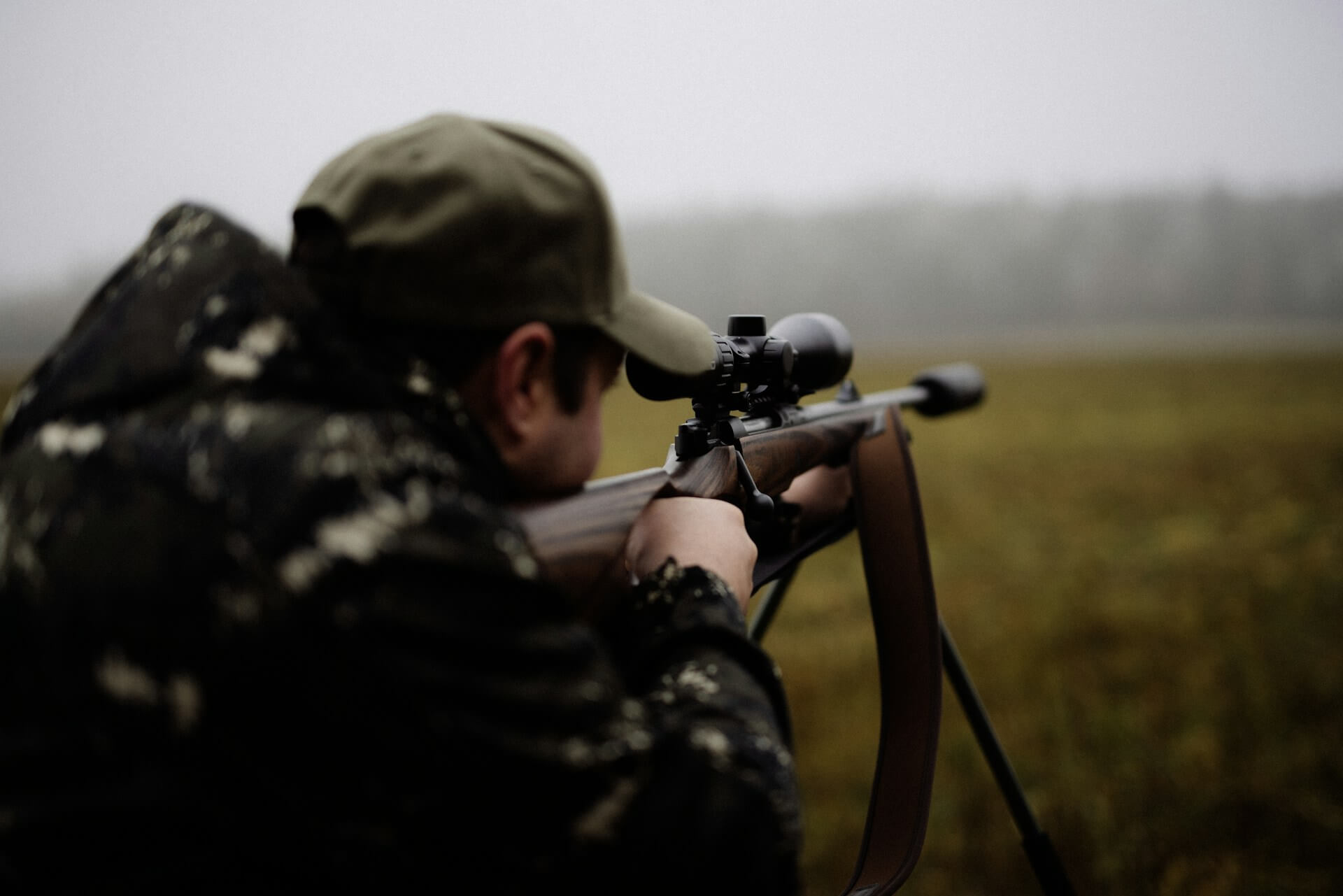
How to choose the right riflescope
Choosing the right riflescope can be a difficult task. Perhaps you are buying your first scope, or perhaps you are looking for a better, more precise hunting scope than the one you already own. Whatever your level of experience, it is important to understand the basics so you can choose a riflescope that suits your style of hunting.
When buying a riflescope, you should always start by considering the type of hunting you do most often. Distances, terrain and light conditions all play a major part in choosing the right scope. A riflescope for driven hunting needs very different features from one used for hunting from a high seat or stalking.
Objective lens diameter and magnification
To understand a riflescope's characteristics, you need to know what magnification and objective lens diameter mean. These are usually expressed as two numbers, for example 7x42.
The first number indicates the magnification and tells you how many times closer the subject appears through the scope. A magnification of 7 means that the object you are looking at appears seven times closer than it actually is. The second number indicates the objective lens diameter in millimetres, which has a significant effect on how much light the scope can gather.
A riflescope with a smaller objective lens diameter often provides a wider field of view and greater depth of field, but less detail. A scope with a larger objective lens diameter provides more detail and better light transmission, but a narrower field of view and shallower depth of field. You should therefore always consider whether you mainly hunt at short or long ranges before choosing the magnification and objective lens diameter.
Variable-magnification riflescopes
A variable-magnification riflescope is a popular choice because it can be used for several different types of hunting. Variable magnification allows you to adjust the scope easily to suit the distance, terrain and situation.
Low magnification, for example 1 to 4 times, is particularly suitable for driven hunting and hunting at short ranges, where a wide field of view and rapid target acquisition are essential. Medium magnification of around 6 to 8 times is often used for stalking and typical high-seat hunting, providing a good balance between detail and an overall view. Higher magnification of 10 to 12 times is mainly used for longer shots, where precision and detail matter most.
For all-round hunting, many hunters choose a riflescope with a magnification range of 2 to 10 times or 3 to 12 times. These ranges cover most hunting situations in Denmark and make the scope highly versatile.
Thermal scopes
If you often hunt in darkness or very low light, a thermal scope can be a useful addition or alternative to a conventional riflescope.
A thermal scope works by detecting heat signatures from animals and their surroundings. Animals appear as distinct, glowing shapes through the scope, even when they cannot be seen with the naked eye. Thermal scopes are used particularly for wildlife control and night hunting, where their use is permitted by law.
Other important terms you should know
When choosing a riflescope, you will often come across technical terms that can be difficult to make sense of. Here we explain some of the most important terms to help you understand a scope's specifications.
Field of view
The field of view indicates the width of the area you can see through the riflescope at a distance of 1,000 metres. A wide field of view makes it easier to track moving game and is particularly useful on driven hunts.
Some manufacturers specify the field of view in degrees rather than metres. As a rule of thumb, one degree corresponds to approximately 17.5 metres.
Lens coatings
A coating is a very thin chemical layer applied to the lenses in a riflescope. Its purpose is to increase light transmission and reduce reflections, producing a clearer image with better contrast.
There are several types of coating, but fully coated and fully multi-coated lenses are generally considered the best choices, especially for hunting at dusk and in poor light.
Exit pupil
The exit pupil indicates how much light leaves the scope and reaches your eye. This is particularly important when hunting at dusk and in darkness, when your eye needs more light.
For daylight hunting, an exit pupil of 2 to 3 millimetres is usually sufficient. For hunting at dusk, the exit pupil should be at least 5 millimetres.
The exit pupil is calculated by dividing the objective lens diameter by the magnification. A 7x42 riflescope therefore has an exit pupil of 6 millimetres, making it well suited to hunting in poor light.
Conclusion
Choosing a riflescope is about finding the right combination of magnification, objective lens diameter, light transmission and intended use. By understanding the key terms and considering your style of hunting, you will be much better equipped to choose a riflescope that meets your needs both now and in the future.